How to play marbles
New to marbles? Learn the words, how to hold and flick a shooter, how to set up a ring and three easy first games for kids and grown-ups.

Marbles is one of the oldest games there is. Long before glass marbles existed, children played with round pebbles, nuts and fruit pits [1]. Today you need very little to start: a handful of marbles, a bigger one to shoot with, and a flat patch of ground. This guide covers the words you will hear, how to shoot, and three easy games to try first.
What you need
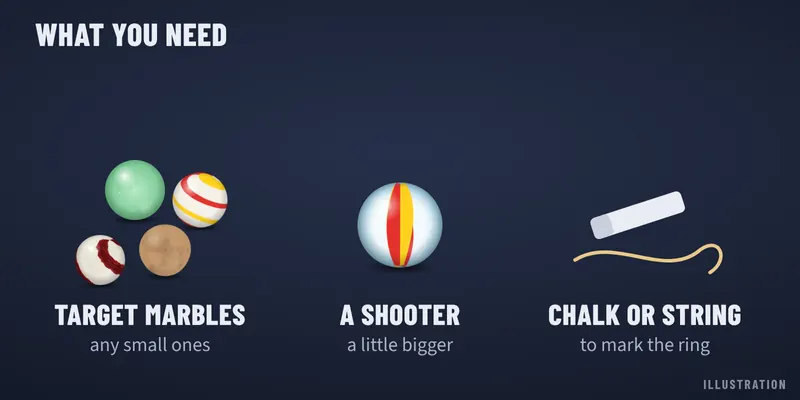
- Target marbles. Any small marbles will do. In the US National Marbles Tournament, the targets are glass marbles 5/8 inch (about 16 mm) across [5].
- A shooter. Each player has one slightly bigger marble to shoot with. In the US tournament it must be between 1/2 and 3/4 inch across and made of glass or stone, never metal [5].
- A playing surface. Packed dirt, a smooth floor, a short carpet or a paved yard all work. Very bumpy ground makes aiming a matter of luck.
- Something to mark a ring. Chalk on pavement, a stick in dirt, or a loop of string or yarn on a carpet.
The words you will hear
Marble players have their own vocabulary, and it changes from place to place. A few common ones [7]:
- Shooter or taw: the bigger marble you shoot with. In Britain it is often called a tolley [6].
- Ducks: the marbles you are trying to hit.
- Knuckle down: the shooting position, with a knuckle on the ground.
- Keepsies: playing so that you keep the marbles you win.
- Lagging: a quick contest to decide who goes first [5].
How to shoot: knuckling down
The classic shot is a flick of the thumb, not a throw.
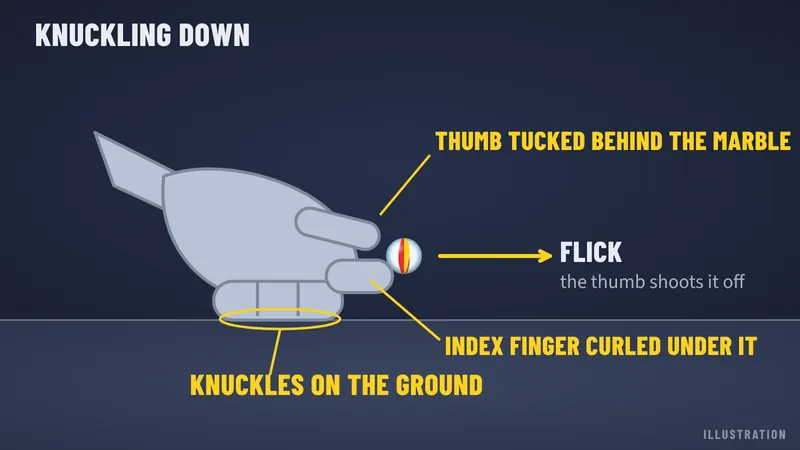
- Curl your index finger and rest the shooter in the bend of it [3].
- Tuck your thumb behind the marble.
- Put at least one knuckle of your shooting hand on the ground. This is called knuckling down [1][5].
- Aim, then flick your thumb forward to send the shooter off.
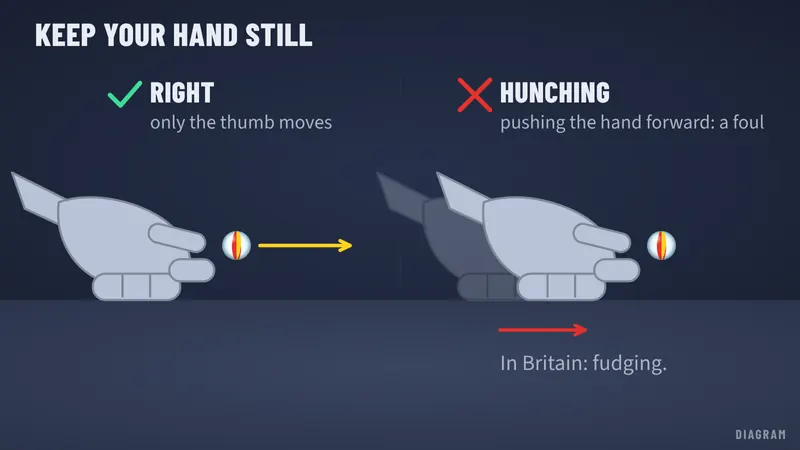
Your hand should stay still while you shoot. Pushing your hand forward as you flick gets you closer to the target, so tournaments treat it as a foul. In the US it is called hunching [5], and at the British championship it is called fudging [6]. If knuckling down feels hard at first, younger children can simply flick the marble with a finger instead [2].
Deciding who goes first: lagging
In a lag, each player shoots or tosses their shooter toward a line drawn on the ground. Whoever gets closest to the line goes first [5]. In casual play you can also just take turns, or flip a coin.

Three easy first games
1. A simple ring game
This is the game most people picture when they think of marbles. It is a casual cousin of the tournament game Ringer.
- Tie a piece of string to a pencil and draw a circle, or lay a loop of string on the floor. A bigger ring makes the game harder and a smaller ring makes it quicker [3].
- Put a few marbles from each player in the middle.
- Take turns shooting from outside the ring, trying to knock marbles out of it.
- If you knock a marble out and your shooter stays inside the ring, shoot again from the spot where it stopped [3].
- When you miss, it is the next player's turn.
- Whoever has knocked out the most marbles when the ring is empty wins.

2. Conqueror
A good game for two or more players on open ground [2].
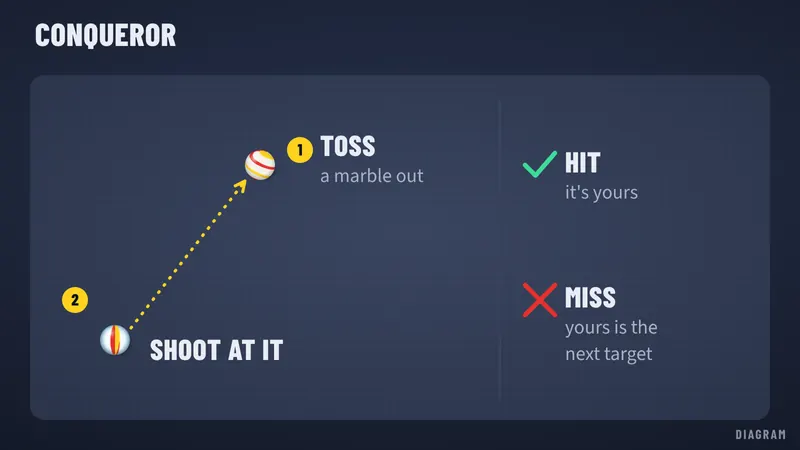
- The first player tosses a marble onto the ground.
- The next player shoots at it. A hit captures the marble.
- After a hit, the shooter puts down a new marble to start the next round. After a miss, the shooter's marble stays where it landed and becomes a new target.
- Play until one player has all the marbles, or until everyone has had enough.
3. Hundreds
A two-player game scored in points, so nobody loses any marbles [2].
- Draw a small circle a few feet away.
- Both players shoot toward it.
- If both marbles land inside, or both land outside, shoot again.
- If only one player's marble lands inside, that player scores 10 points and keeps shooting, scoring 10 more each time they land inside, until they miss.
- The first player to reach 100 points wins.

Playing for fun or for keeps
Before you start, agree on whether marbles change hands.
- Playing for keeps (keepsies) means the marbles you win are yours to keep. Many people who grew up with marbles remember it this way. One writer at The Strong museum recalls the chant "Winner keeps, loser weeps!" [4]
- Playing for fun means everyone gets their own marbles back at the end. You count the marbles you knocked out, or keep score in points as in Hundreds.
Playing for keeps is an option, not the default. With young children it often ends in tears, and The Toy Association's Genius of Play site advises against it for younger and less experienced players [3]. For family games, play for fun.
Simple variants
Kids have always changed the rules to suit the ground they play on [4]. A few easy ways to mix things up:
- Hole games. Dig or mark a small hole and shoot marbles into it. Britannica calls these pot games [1], and the Strong museum mentions one called rolly hole, also known as rabbit hole or poison hole [4].
- Hit and span. Shoot or roll at another player's marble. You win if you hit it or stop within a hand's span of it [1].
- Odd or even. A no-shooting game for rainy days. One player hides some marbles in a closed hand and the other guesses odd or even. A right guess wins a marble, a wrong guess loses one [2].
- Change the ring. Make it bigger for older players, or put fewer marbles in the middle for a quicker game.
Fair play tips
- Agree on the rules before the first shot, especially keeps or fun.
- Shooters stay out of the ring until it is your turn.
- Wait for all the marbles to stop rolling before the next shot.
- Pick up your marbles when you finish, so nobody slips on one.
- Small marbles are a choking hazard. Keep them away from babies and toddlers.
Play it online
On Marble Spins, marbles race down tracks under real physics, and it is free to play in your browser. It is a different kind of marble game, and a fun one for a rainy day.
Sources
- Marble (toy) – Britannica — Early marbles made of pebbles, nuts and fruit pits; the families of marble games (ring, hit and span, pot games, bridgeboard); the knuckling shot
- Marble games – The Judge's Lodging museum — Basic shooting technique and the rules of Conqueror, Hundreds and Odd or Even
- Marbles Game – The Genius of Play (The Toy Association) — Drawing a ring with string, ring size and difficulty, shooting from where the shooter stops, advice against playing for keeps with young children
- Playing for Keepsies – The Strong National Museum of Play — Keepsies as a schoolyard tradition, hole games, kids changing rules to suit the ground
- Tournament Rules – US National Marbles Tournament — Lagging, knuckling down, hunching, marble and shooter sizes
- Rules – British and World Marbles Championship, Tinsley Green — Knuckling down and the fouls called fudging and cabbaging
- Marble (toy) – Wikipedia — Common marble words (taw, ducks, keepsies, knuckle down)