A short history of marbles
From stone balls in ancient graves and Roman nut games to German glass, American machines and Tinsley Green: a short, careful history of marbles.
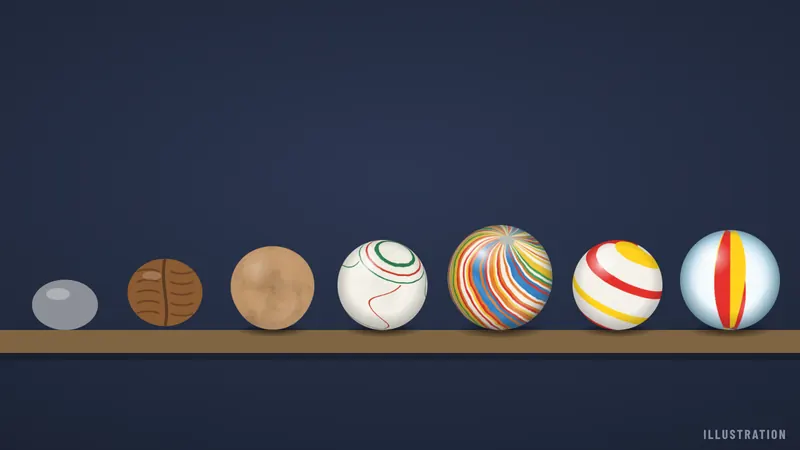
Marbles feel timeless, and in a way they are. But a lot of what gets repeated about their history is guesswork. This short history sticks to what museums, collectors' societies and historians can actually show, and says so when the evidence is thin.
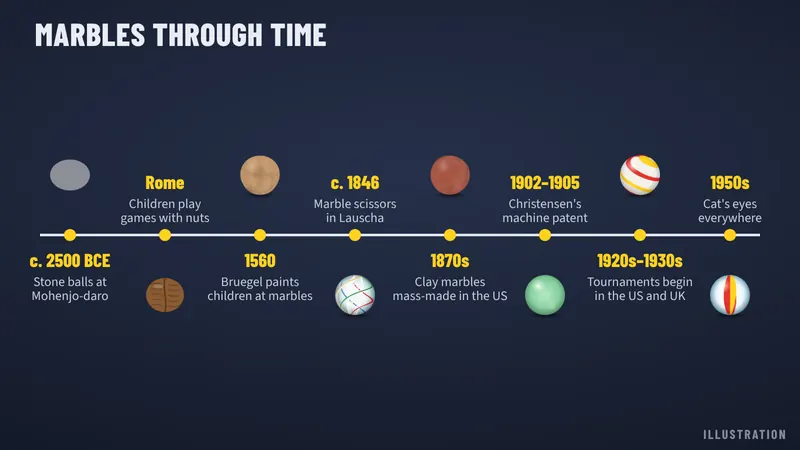
Ancient beginnings
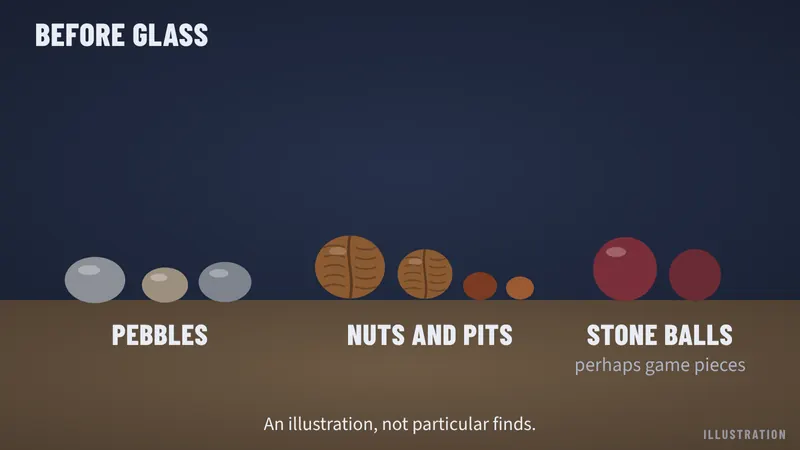
The first "marbles" were not made at all. Britannica says early players used sea-rounded pebbles, nuts or fruit pits [1]. That makes the very earliest games hard to spot, because a round pebble in the ground could be a toy, a tool or just a pebble.
Some finds are suggestive:
- The Indus Valley. Small stone balls from Mohenjo-daro, from about 2500 BCE, are often described as marbles [2]. At Harappa, another Indus city, the excavator Madho Sarup Vats wrote in 1940 that "balls and marbles in stone, shell, faience and pottery" were among the objects that could be said to be unmistakably for games [20].
- Egypt. The Petrie Museum in London holds a set of small porphyry balls from a grave at Naqada, dated to the Naqada III period, late in Egypt's prehistory. The museum catalogues them as "perhaps gaming pieces" [3]. That is the honest answer: they may have been used in a game, but nobody can say they were marbles.
- North America. Britannica notes that engraved marbles have been found in earthen mounds built by some early Native American peoples [1].
Rome: games with nuts
Roman children played games with nuts, and Britannica says the young Octavian, the future Emperor Augustus, played with nut marbles like other Roman children [1]. The Roman writer Suetonius says that the grown-up Augustus relaxed by playing games with little boys. The classic Latin dictionary by Lewis and Short cites this passage for children playing with nuts [21]. One well-known English translation renders the game pieces as "dice, marbles and nuts" [4], so the "marbles" there are the translator's word.
A Roman poem called the Nux ("The Walnut Tree") is often quoted in marble histories. It was once credited to Ovid, but scholars now consider it the work of someone else [5].
Medieval and early modern Europe
Written evidence from the Middle Ages is patchy. By the 16th century the picture is clearer. Pieter Bruegel the Elder's painting Children's Games (1560), now in the Kunsthistorisches Museum in Vienna, includes children playing marbles among the dozens of games it shows [6].
The English word itself comes from stone. Britannica explains that the name comes from the 18th-century practice of making marbles from chips of marble [1]. In parts of Germany and Austria, stone marbles were ground into shape in water-powered mills on streams, and working historic mills survive at Neidlingen in the Swabian Alps and Seeham in Austria [8].
German glass marbles
The marbles collectors prize most today come from the glassmaking villages of Thuringia, in central Germany, above all Lauscha.
- Around 1846, a tool called the marble scissors (Märbelschere) was developed in Lauscha. It let glassworkers round off and cut marbles from a rod of patterned glass [7][8]. Sources disagree about exactly who invented it, so it is fairest to credit the Lauscha glassmakers rather than one person.
- Playing marbles were being made by about 1850, and German handmade marbles were produced until just before the Second World War [7].
- Lauscha stayed the world's marble capital until the early 20th century [8].

German makers lost their lead in the early 1900s. The Marble Collectors Society of America points to three reasons: American machines that could mass-produce marbles, the cut-off of German imports during the First World War, and US import tariffs in the 1920s [7].
Clay and china
For most children, though, the everyday marble was clay. The Marble Collectors Society of America calls clay marbles "the most common old marble that you will find" [9]. Many were made in Germany, including the glazed clay marbles collectors call "Benningtons", a name that turns out to be a misnomer [9]. In the US, The Strong National Museum of Play says mass production of clay marbles began in the 1870s [10]. China marbles, made of glazed porcelain, were another kind [2].
The American machine age
The big change came in Akron, Ohio. Martin F. Christensen filed a patent for a "machine for making spherical bodies or balls" on 19 December 1902. It was published as US patent 802,495 on 24 October 1905 [11]. His company made machine-made glass marbles in Akron from 1904 to 1917 [12]. (You will see other start dates, such as 1903, in some histories.)
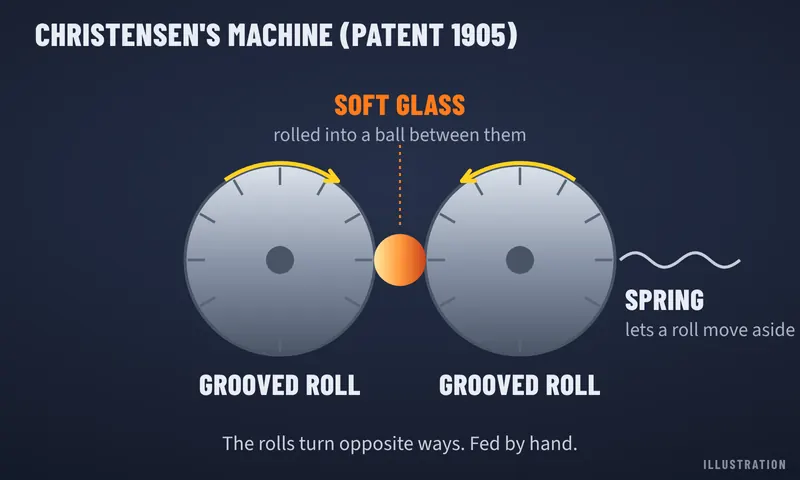
Ohio and West Virginia soon became marble country. West Virginia already had a strong glass industry, and by the late 1930s several marble plants were running there [13].
- Akro Agate was founded in Akron in 1910 [13][14], or 1911 by some accounts [2], moved to Clarksburg, West Virginia, in 1914, and closed in 1951 [13][14].
- Vitro Agate was making marbles in Vienna and Parkersburg, West Virginia, from 1932 [13].
- Marble King was founded in 1949 by Berry Pink and Sellers Peltier. After a fire in January 1958 it moved to Paden City, West Virginia, where it still makes marbles [15].
By the 1950s the cat's eye, a clear marble with a colored vane inside, was common. The Marble Collectors Society of America says cat's eyes became the main marble after the Second World War, made both in East Asia and in the US [16]. Marble King's Roger Howdyshell is credited with the first American-made ones [15], but who made the very first cat's eye is disputed.
Interest in marbles as a children's game peaked in the first half of the 1900s and declined after the 1950s, partly because of electronic entertainment [10].
Tournaments
Two famous events keep competitive marbles alive.
- Tinsley Green, England. Local legend says marbles were played at Tinsley Green, West Sussex, as far back as 1588, when two young men supposedly settled a contest over a local girl with a game of marbles. The modern championship began in 1932 and became the British and World Marbles Championship in 1938. It is played every Good Friday at the Greyhound pub, by teams of six [17].
- Wildwood, USA. The US National Marbles Tournament began in the early 1920s. The tournament itself gives 1922 [18], and other accounts, including Wikipedia, give 1923 [19]. It has been held in Wildwood, New Jersey, since 1960 [19].
Marbles today
Most glass marbles made today are not toys. The West Virginia Encyclopedia notes that most production goes to industry, for example as the agitator balls in aerosol cans, and into decorative glass [13]. Marble King says it makes more than a million marbles a day [15].
Handmade marbles have come back too. Glass marbles have been made by hand in Lauscha again since 1975 [8], and from the late 20th century a new wave of glass artists began making marbles as art [13].
Play it online
On Marble Spins, marbles race down tracks under real physics, and it is free to play in your browser. It's a new chapter for an old toy.
Sources
- Marble (toy) – Britannica — Pebbles, nuts and fruit pits; Augustus and nut marbles; marbles in North American mounds; materials; origin of the name
- Marble (toy) – Wikipedia — Stone balls at Mohenjo-daro; Akro Agate founding year 1911
- Porphyry balls, LDUCE-UC5174 – Petrie Museum of Egyptian and Sudanese Archaeology, UCL — Naqada III stone balls from a grave, catalogued as "perhaps gaming pieces"
- Suetonius, Life of Augustus 83 (English translation) – Lexundria — Augustus playing "at dice, marbles and nuts with little boys"
- O'Hearn, L. (2023) Nocet esse feracem: An Ecofeminist Analysis of the Pseudo-Ovidian Nux – Maynooth University — The Nux is no longer thought to be by Ovid
- Children's Games (Bruegel) – Wikipedia — The 1560 painting in Vienna that includes children playing marbles
- Handmade Marbles – Marble Collectors Society of America (marblecollecting.com) — Marble scissors c. 1846 in Lauscha; German handmade marbles c. 1850 to just before WWII; why German dominance ended
- Spheres of glass and stone – Spielwarenmesse magazine — Lauscha glassmakers and the marble shears; stone marble mills; handmade marbles again in Lauscha since 1975
- Earthenware – Marble Collectors Society of America (marblecollecting.com) — Clay as the most common old marble; German clay and "Bennington" marbles
- Playing for Keepsies – The Strong National Museum of Play — US mass production of clay marbles from the 1870s; peak popularity in the first half of the 1900s; decline after the 1950s
- US Patent 802,495, Machine for making spherical bodies or balls – Google Patents — Christensen's patent, filed 19 December 1902, published 24 October 1905
- M.F. Christensen & Son Co. – Marble Collectors Society of America (marblecollecting.com) — Christensen company in Akron, 1904 to 1917
- Marbles – e-WV: The West Virginia Encyclopedia — West Virginia marble industry; Akro Agate 1910, Clarksburg 1914, closed 1951; Vitro Agate; industrial uses today; art-glass revival
- Akro Agate Co. – Marble Collectors Society of America (marblecollecting.com) — Akro Agate founded 1910 in Akron, moved 1914, bankrupt 1951
- Marble King – e-WV: The West Virginia Encyclopedia — Marble King founded 1949; 1958 fire and move to Paden City; first American-made cat's eyes credited to Roger Howdyshell; output today
- Marble FAQ – Marble Collectors Society of America (marblecollecting.com) — Cat's eyes as the main marble after World War II, made in the Far East and the US
- British and World Marbles Championship – Wikipedia — Tinsley Green, the 1588 legend, the 1932 start of the modern event, the 1938 renaming
- US National Marbles Tournament – official site — Founding year given by the tournament (1922); Wildwood venue
- National Marbles Tournament – Wikipedia — Alternative founding year (1923); Wildwood since 1960
- Ivory chess disc and two chess figures (Vats, Excavations at Harappa, 1940) – Harappa.com — Vats's 1940 note that balls and marbles of stone, shell, faience and pottery were unmistakably game objects at Harappa
- nux – Lewis & Short, A Latin Dictionary — Children playing with nuts, citing Suetonius, Augustus 83