Ringer rules
How Ringer works, as played at the US National Marbles Tournament: 13 marbles in a cross, a 10-foot ring, lagging, knuckling down, fouls and first to 7.

Ringer is the marble game played at the US National Marbles Tournament, held every year on the boardwalk in Wildwood, New Jersey [2]. Two players take turns shooting at 13 marbles set out in a cross in the middle of a 10-foot ring. The first to knock out seven wins. The rules below follow the tournament's official rules [1]. Schoolyard games are often looser, and local clubs may play slightly differently.
A little background
The national tournament began in the early 1920s. The tournament's own website gives 1922 [2], while other accounts, including Wikipedia, give 1923 [3]. It has moved between several New Jersey shore towns and has been held in Wildwood every year since 1960, apart from 2020 and 2021, when it was canceled during the COVID-19 pandemic [3]. Players, often called mibsters [4], must be local champions aged 7 to 14 [1]. The tournament says it runs more than 1,200 games over four days, and each year national champions win college scholarships [2].
Ringer is not Ring Taw
Britain's big marble event, the British and World Marbles Championship at Tinsley Green, plays a different game called Ring Taw. It uses a 6-foot ring, 49 marbles packed in the middle, teams of six, and the first team to 25 wins [5]. Britannica notes that ring games in general are played in rings about 6 to 10 feet across, sometimes with the marbles in a cross [6]. So if you read "ringer" in a British source, check which game is meant.
Equipment
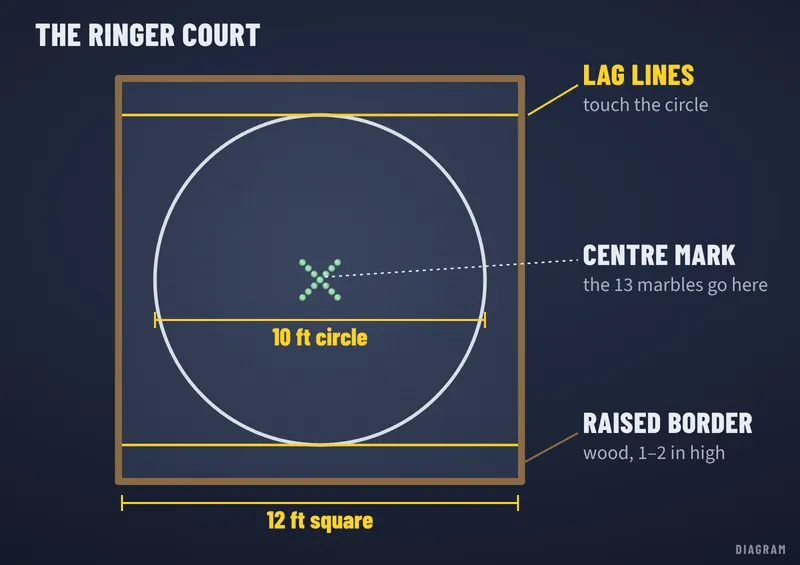
- The ring. The tournament plays on a 12-foot square of concrete with a raised wooden border about 1 to 2 inches high. A circle 10 feet across is painted in the middle, with a center mark and two lag lines that touch the circle and run parallel to the border [1]. At home, a 10-foot circle in chalk or string works fine.
- Target marbles. 13 identical glass marbles, the standard 5/8 inch (about 16 mm) size [1].
- Shooters. Each player has one shooter, different from the targets. It must be glass or stone, such as agate or flint, never metal, and between 1/2 and 3/4 inch across. Shooters are measured before the tournament and may only be swapped at the start of a game [1].
Setting up: the cross
The 13 marbles are placed in an X: one in the center, with three more along each of the four arms, spaced 3 inches apart, center to center [1]. Tournaments use a template called a rack to place them exactly. The player who shoots first chooses the angle of the X [1].

Lagging: who goes first
Both players stand or kneel at the edge of the circle farthest from a lag line and toss their shooters toward it at the same time. The shooter that stops closest to the line wins the lag and that player goes first [1]. A lag is lost if the shooter hits the rack or the border, or if the player cups it. If both players foul, they lag again. Lagging is also used to break a tie at the end of a game [1].

Shooting
Every turn starts from outside the ring, with the player crouching or kneeling and one foot touching the wooden border [1].
- Knuckle down. The shooting hand must stay outside the circle, with at least one knuckle touching the ground. The marble must not be above or inside the circle when it is released [1].
- No hunching. Pushing the hand forward while shooting is called hunching. It costs you the shot [1].
- Practice. Each player may take up to two practice shots outside the ring at the start of each inning [1].
- Slips. If the shooter slips out of your hand and rolls less than ten inches, you may shoot again. If it rolls farther, your turn ends [1].
Scoring
- Each target marble knocked completely out of the circle scores one point [1].
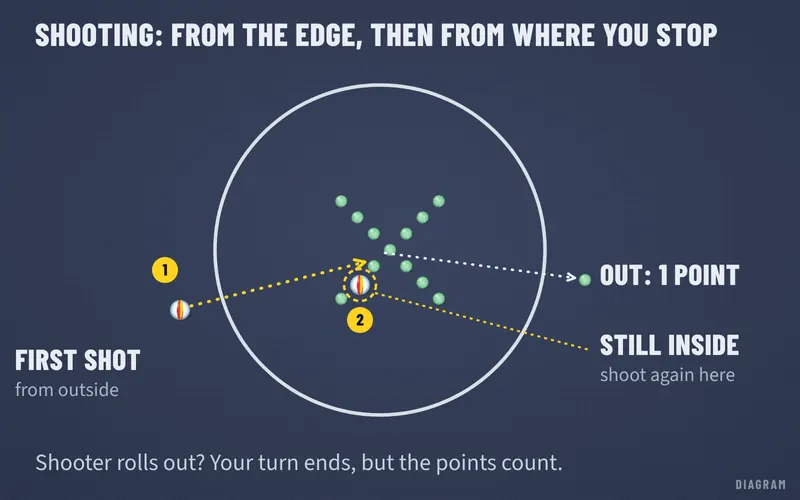
- If your shooter stays inside the circle, you keep shooting. Your next shot is taken from the spot where your shooter stopped, with your hand in or above that spot [1].
- If your shooter rolls out of the circle, your turn ends, but the points you scored on that shot still count [1].
- If you knock nothing out, your turn ends [1].
- All marbles must stop moving before you shoot again. Picking up a shooter while it is still rolling or spinning ends your turn [1].
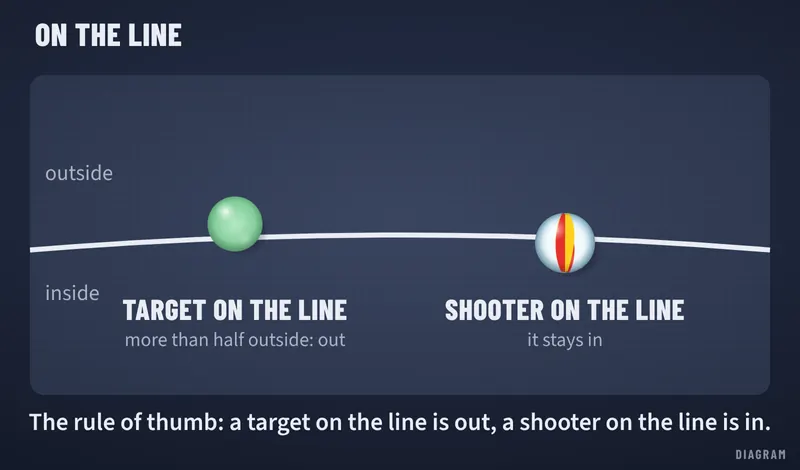
Marbles on the line. A marble resting on the line is out if more than half of it is outside the circle. The rules sum this up as: a target on the line is out, a shooter on the line is in [1].
Winning
- First to seven. A player who knocks out seven marbles wins straight away. Seven or more in the first inning is called a stick and wins the game [1].
- Innings. An inning is complete when both players have shot once from the edge of the ring. The official rules set a limit on the number of innings in a game. If the game is still tied at the end, up to two more innings are played, and then a lag decides [1].
- Finals. In the final games there is no inning limit, and play goes on until someone reaches seven [1].
- Otherwise, the player with the most marbles at the end of the last inning wins. The National Marbles Committee may shorten games to keep the schedule [1].
Fouls and penalties
- Hunching, or a hand inside or above the circle: you lose the shot [1].
- Shooting with the wrong shooter: you lose the turn [1].
- Hitting yourself. If your shooter hits you, your turn ends. Marbles knocked out on that shot still count, except one that hit you, which goes back [1].
- Cupping. You may shield your shooter from the wind with your hands, as long as it doesn't touch them, but you may never cup a target marble. Doing so sends the marble back to the center and ends your turn [1].
- Walking through the ring. Players walk around the ring, not across it. Breaking this rule earns a warning, then a lost point [1].
- Coaching. Nobody may coach during a game. The first time brings a warning, and the second removes the coach from the playing area [1].
- Wind. Target marbles blown out of the ring by wind count for the shooter. Marbles moved by wind alone go back to where they were [1].
A forfeited point puts one marble back in the center. A player with no points who forfeits one loses their next turn [1]. The referee's decision is final during a game, and the National Marbles Committee has the last word on what the rules mean [1].
Where rules vary
- Home and school games often use a smaller ring, any number of marbles, and more than two players.
- Keeps or fun. The tournament plays for points only. In casual games, agree in advance whether anyone keeps the marbles they win.
- Local tournaments may set their own ages, inning limits or time limits. Check with the organizer.
- The rules change over time. The official rules document carries no year or edition, so check the tournament's website for the current version before you rely on a detail.
Play it online
On Marble Spins, marbles race down tracks under real physics, and it is free to play in your browser. It is not Ringer, but it is a quick marble fix between games.
Sources
- Tournament Rules – US National Marbles Tournament (rules and equipment PDF) — All tournament rules (equipment, ring, rack, lagging, shooting position, scoring, fouls, innings, eligibility)
- US National Marbles Tournament – official site — Founding year given by the tournament, Wildwood boardwalk venue, number of games, scholarships
- National Marbles Tournament – Wikipedia — Alternative founding year (1923), host towns over the years, Wildwood since 1960
- Playing for Keepsies – The Strong National Museum of Play — Players called mibsters; schoolyard Ringer in a dirt circle
- Rules – British and World Marbles Championship, Tinsley Green — How the British game Ring Taw differs (6-foot ring, 49 marbles, teams of six, first to 25)
- Marble (toy) – Britannica — Ring games played in rings about 6 to 10 feet across, sometimes with marbles in a cross