How glass marbles are made
Cane-cut handmades, marble scissors and punties, then the machines that turned out marbles by the million. How a glass marble is made, step by step.

A glass marble looks simple: a small, perfectly round ball. Getting molten glass into that shape, with a swirl of color locked inside, took glassmakers a lot of ingenuity. There are two main ways to do it: by hand, one marble at a time, or by machine, by the thousand.
Before glass: clay and stone
The oldest marbles were not glass at all. Clay marbles were made by rounding small bits of clay and firing them in a kiln or oven. They often show small rough spots where they touched each other during firing [2]. Stone marbles were ground into shape in water-powered mills on streams, where rough stone was worn into spheres. Historic mills still work in Neidlingen in Germany and Seeham in Austria [3].
Handmade glass marbles
Glass marbles took off in the mid-1800s in the glassmaking town of Lauscha, in Thuringia, Germany. The key tool was the marble scissors (in German, Märbelschere), which appeared around 1846 [1]. It was adapted from tongs used to make glass eyes for dolls and stuffed animals [1][3]. Lauscha's glassmakers were also inspired by the polished agate spheres of the gemstone town of Idar-Oberstein [3].
There are two handmade methods.
Cane-cut marbles
Almost all old handmade glass marbles were made this way [1].
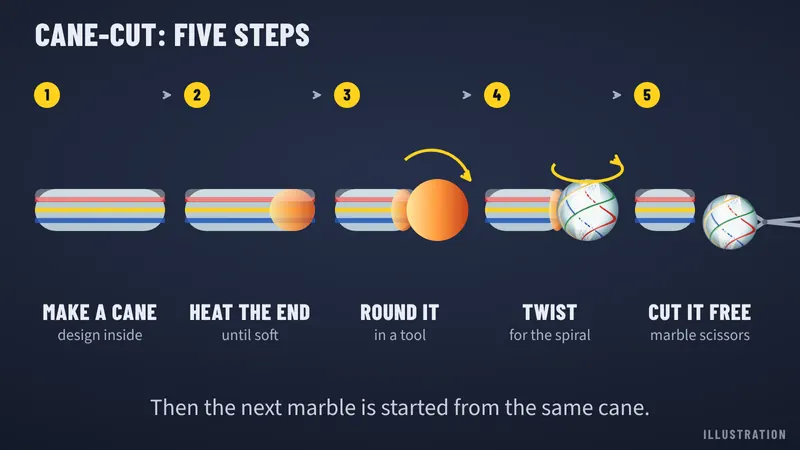
- Make the cane. The glassmaker builds a long rod of glass, called a cane, with the design running through it, for example thin rods of colored glass for a swirl [1][2].
- Heat the end. The end of the cane is heated until it is soft.
- Round it off. The soft end is turned in a hand-held rounding tool until it forms a ball [2].
- Twist. As the end is rounded, it is also twisted. That twist is what gives many handmade marbles their spiral, or helix, pattern [2].
- Cut it free. The ball is snipped off the cane with the scissors, and the next marble is started from the same rod [2].
Making one handmade swirl could take between four and twelve separate steps by hand [1].
Single-gather marbles
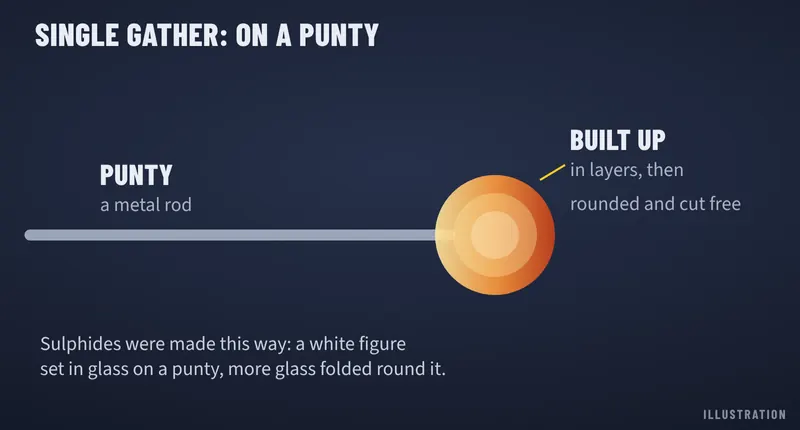
The other method builds one marble at a time on the end of a metal rod called a punty [1]. A blob of glass is built up in layers on the punty, rounded, and then cut free [2]. Sulphide marbles, with a small white figure inside, were made in a similar way: a heated figure was pressed into glass on a punty, or wrapped in glass from a heated rod, and more glass was folded around it [6].
The pontil mark
Every handmade glass marble has at least one pontil: a small rough spot at one pole where it was cut off the cane or the punty [1]. Collectors use it to tell handmade marbles from machine-made ones.

Machine-made marbles
Until the early 1900s, all glass marbles were handmade [11]. That changed in Akron, Ohio.
Christensen's machine
Martin F. Christensen filed a patent for a "machine for making spherical bodies or balls" on 19 December 1902. It was published as US patent 802,495 on 24 October 1905 [4]. His patent describes:
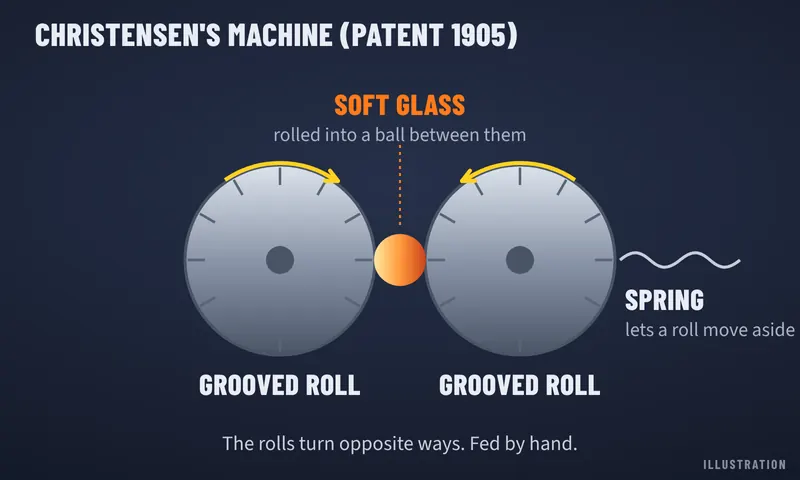
- two grooved rolls with their grooves facing each other, set so they almost touch;
- a chain drive that turns the rolls in opposite directions, so a soft lump of glass fed in between them is rolled into a sphere;
- a spring-loaded mounting that lets one roll move aside when the ball is big enough, so the finished marble drops out [4].
Christensen's machines were not automatic. They had no automatic feed, so the glass had to be fed in by hand [5]. His marbles were made from a single stream of glass, in one or two colors [5].
The modern method
Later machines automated the whole process. The Marble Collectors Society of America describes it like this [2]:
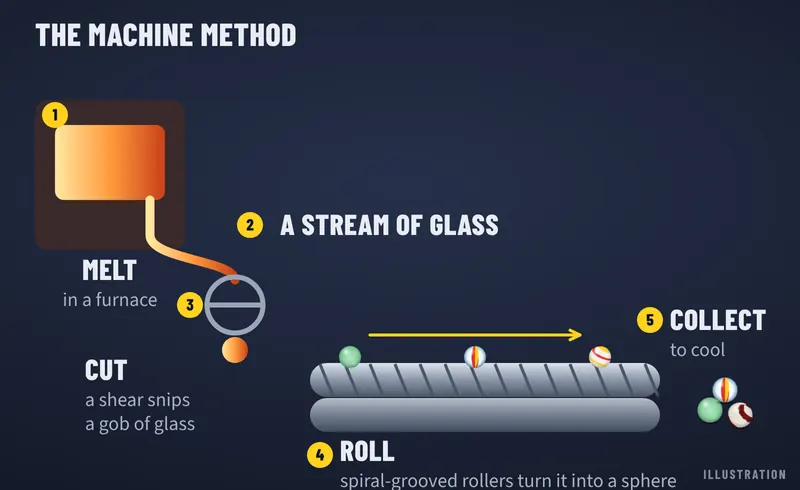
- Melt. Glass is melted in a furnace.
- Feed. A stream, or several streams, of molten glass flows out through a small opening.
- Cut. A rotating shear snips off a measured gob, enough for one marble.
- Roll. The gob drops onto a pair of long, spiral-grooved rollers turning in opposite directions. As it travels along the rollers, it is turned and pressed into a sphere.
- Collect. The finished marbles roll off the end to cool.
Done this way, a factory can make a huge number of marbles. Marble King in West Virginia says it makes more than a million marbles a day [12]. Most go to industry rather than toy boxes, for example as the agitator balls in aerosol cans [11].
Where the color comes from
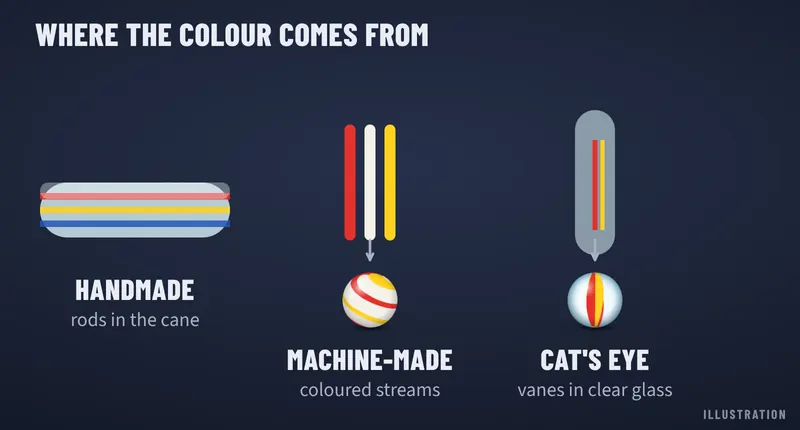
- Handmade marbles get their designs from the cane. Colored rods and strands are built into the cane before it is heated, so every marble cut from it shares the design [1][2].
- Machine-made marbles get their color from the glass streams. Feeding several streams of different colored glass together gives multicolored marbles [2].
- Cat's eyes are made by injecting colored glass vanes into a stream of clear glass as it is made [10].
The glass itself is usually colored by a metal oxide dissolved in it, one of the ways glassmakers color glass [13].
Annealing: the slow cool
Hot glass can't just be left to cool on a bench. If it cools too fast, it is left strained inside and may break, either while cooling or much later [7]. So glassmakers anneal it, cooling it slowly in a special oven called a lehr [7][8]. Historic lehrs were long tunnels that the glass was slowly pushed through; today they work with conveyor belts [8].
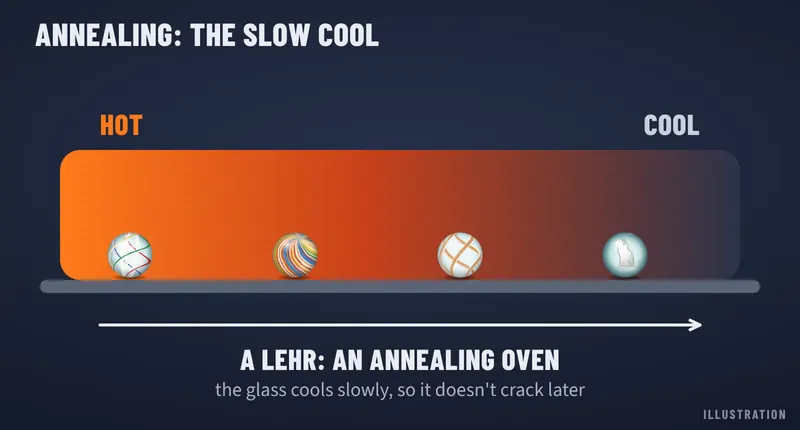
Handmade sulphide marbles were put in an annealing chamber to cool slowly and avoid breaking [6]. Glass artists who make marbles today still do the same. One describes putting each finished marble into an annealing oven to cool over a 12-hour period [9].
Handmade marbles today
Machines took over the toy market, but handmade marbles never fully disappeared. Glass marbles have been made by hand in Lauscha again since 1975 [3], and many glass artists now make marbles as works of art, using the same punty, shears and annealing oven as the old masters [9].
Play it online
On Marble Spins, marbles race down tracks under real physics, and it is free to play in your browser. Each racer has a classic glass look, but looks never change who wins.
Sources
- Handmade Marbles – Marble Collectors Society of America (marblecollecting.com) — Cane-cut and single-gather marbles; the pontil; marble scissors c. 1846 in Lauscha; four to twelve steps for a handmade swirl
- Marble FAQ – Marble Collectors Society of America (marblecollecting.com) — How cane-cut, single-gather and machine-made marbles are made; the helix twist; streams of glass, rotating shears and helical rollers; clay marbles
- Spheres of glass and stone – Spielwarenmesse magazine — The Märbelschere adapted from tongs for glass eyes; agate spheres as inspiration; stone marble mills; handmade marbles in Lauscha since 1975
- US Patent 802,495, Machine for making spherical bodies or balls – Google Patents — How Christensen's machine worked (two grooved rolls turning in opposite directions); filing and publication dates
- M.F. Christensen & Son Co. – Marble Collectors Society of America (marblecollecting.com) — Christensen machines were fed by hand; one- and two-color marbles; company dates
- Go Figure: sulphide marbles – Maryland Archaeological Conservation Laboratory — How sulphide marbles were made around a figure; annealing chamber
- Annealing – Corning Museum of Glass, All About Glass — What annealing is and why glass breaks without it
- Lehr – Corning Museum of Glass, All About Glass — The annealing oven and modern conveyor lehrs
- Marbles – Brian Graham Glass — A present-day glass artist's process (punty, shears, overnight annealing)
- Marble (toy) – Wikipedia — How cat's eye marbles get their colored inserts
- Marbles – e-WV: The West Virginia Encyclopedia — All glass marbles were handmade before Christensen's machine; industrial uses today
- Marble King – e-WV: The West Virginia Encyclopedia — Present-day factory output of more than a million marbles a day
- Colored glass – Corning Museum of Glass, All About Glass — Glass colored with a dissolved metallic oxide